

Best eSIM for Asia: Multi-Country Plans, Prices & Coverage (2026)
Asia is where I first realised how powerful a good regional eSIM can be.
I still remember my “old school” trip: landing in Bangkok, buying a Thai SIM; then another SIM in Vietnam; then another in Japan. Every country meant:
-
New kiosk
-
New plan
-
New plastic SIM
-
New “uhh, can you set it up for me?” moment
On my next big route – Japan → South Korea → Taiwan → Thailand → Vietnam – I tried a regional eSIM for Asia instead. One QR code. One plan. My data just… followed me.
In this guide, I’ll share the best eSIM for Asia options I’ve actually used or closely researched, and help you pick the right esim asia based on:
-
Your route (how many countries?)
-
Your data habits (light / normal / heavy)
-
Whether you prefer simple unlimited or flexible fixed-data plans
All based on 2025–2026 reviews from TechRadar, travel bloggers, and eSIM comparison sites – plus my own “learned it the hard way” experience.
Why a Regional esim asia Beats Juggling Local SIMs
There are 48 countries in Asia, and more than a dozen that most travellers bounce between. TechRadar’s October 2025 guide basically says: if you’re moving across borders, regional eSIMs are far more convenient and often cheaper than buying new SIMs each time or roaming.
Here’s why I don’t do “one SIM per country” anymore:
1. One eSIM, many countries
A good esim asia gives you coverage in anywhere from 14 to 30+ countries on a single plan – think Japan, South Korea, Thailand, Vietnam, Singapore, Malaysia, Indonesia, Taiwan, Hong Kong, and more.
No more SIM swaps on every border crossing.
2. No roaming shock
Global & regional eSIMs exist specifically to kill roaming bills. TechRadar’s Asia roundup lists providers like Ubigi, Saily, Airhub, Jetpac and Holafly as significantly cheaper than roaming, especially if you’re visiting multiple countries.
3. Your number stays put
With an esim asia:
-
Your physical SIM (and normal number) stays in your phone
-
You use the Asia eSIM only for data
-
WhatsApp, iMessage, banking apps etc. still see your usual number
4. No kiosk hunting, no language barrier
I love Asia, but:
-
Buying a SIM in Japanese at Narita,
-
Then a different one in Korean at Incheon,
-
Then another in Vietnamese in Hanoi airport…
…gets old fast.
A regional eSIM for Asia means I do the “fiddly setup” once, on my sofa, with coffee.
The Main Types of Asia eSIMs (So You Don’t Get Confused)
When you search for “best eSIM for Asia”, you’ll see three big buckets:
-
Asia-only or APAC regional eSIMs
-
Cover a specific set of Asian countries (e.g. 14–26 countries).
-
Examples: Holafly Asia, Nomad APAC, Saily Asia & Oceania, Airhub Asia.
-
-
Asia + Oceania eSIMs
-
Add Australia, New Zealand, sometimes Pacific islands to the mix.
-
Examples: Saily’s Asia and Oceania eSIM starting from 1GB / 7 days.
-
-
Global eSIMs (Asia included)
-
Work in 100+ countries worldwide, including Asia.
-
Examples: Ubigi global, Holafly Global subscription, many Nomad global plans.
-
If your trip is Asia-only, regional APAC / Asia eSIMs usually offer the best balance of price and coverage.
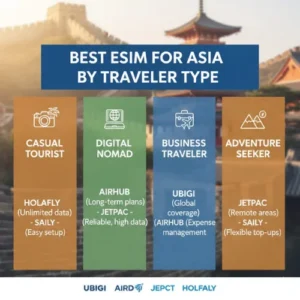 Quick Overview: Best eSIM for Asia by Traveler Type
TechRadar’s “Best eSIMs for Asia in 2025” gives a nice structure I fully agree with:
-
Ubigi – Best Overall: strong performance, 26 Asian countries, 5G in some markets.
-
Saily – Best for Security: 19 Asian countries, built-in ad blocking & web protection.
-
Airhub – Best for Flexibility: big 300GB options, Asia-Pacific + Eurasia coverage.
-
Jetpac – Best for Network Coverage: from US$4, unlimited and tiered plans, 17 countries, smart perks.
-
Holafly – Best for Unlimited Data: unlimited across 16 Asian countries from ~US$3.90/day.
Let me break those down like a traveller, not a tech reviewer.
1. Holafly Asia – Best Unlimited esim asia (Heavy Data Users)
If you want to stop thinking about GB entirely, Holafly Asia eSIM is your “easy mode”.
Holafly’s Asia page highlights:
-
Unlimited data eSIM for Asia with instant delivery & QR activation
-
Coverage in 16 popular countries, including:
-
Japan, South Korea, China (Hong Kong/Macau), Thailand, Vietnam, Singapore, Malaysia, Indonesia, Philippines, Taiwan, Cambodia, Laos, Sri Lanka, Pakistan and more.
-
-
No roaming fees, fixed price per day, easy top-ups
TechRadar’s Asia guide names Holafly the best eSIM for unlimited data in Asia, although it warns it’s pricier than fixed-data options.
From my experience:
-
I used a Holafly esim asia on a Seoul → Tokyo → Taipei → Bangkok trip where I was filming and uploading constantly. Having unlimited data felt amazing.
-
I didn’t check my data usage once; I just used my phone as if I were at home.
Things to know:
-
“Unlimited” = fair-use policies. After a certain amount of high-speed data per day, speeds may be slowed.
-
Hotspot/tethering is often limited or not allowed on some unlimited plans – great for phone-only, less ideal for heavy laptop work.
Best for:
Content creators, social-media lovers and heavy data users who value simplicity over micro-optimizing GB.
2. Nomad APAC – Great Value esim asia (Fixed + Longer Validity)
If you prefer fixed GB + longer validity, Nomad’s APAC eSIM is incredibly solid.
Nomad’s APAC page shows:
-
Regional APAC plans covering 14 or 21 countries (depending on the variant)
-
Example: 20GB / 45 days APAC plan for about US$29 (~US$1.45/GB) valid in 14 countries.
-
4G/5G speeds where available, prepaid with tax included, no contracts
eSIMDB lists several Nomad Asia / APAC regional plans from 1GB (7 days) up to large 20GB–50GB options, plus global plans if you go beyond Asia.
For me:
-
I used a Nomad APAC esim asia on a Japan → Korea → Singapore → Malaysia → Thailand route.
-
20GB / 45 days was a sweet spot: enough data for maps, social media, email, some Netflix, and a few Zoom calls, without feeling nervous.
Best for:
Backpackers and digital nomads doing 2–6 weeks around Asia who prefer fixed data, longer validity and hotspot support over unlimited.
3. Saily Asia & Oceania – Secure & Flexible esim asia
If you care about privacy and security as much as data, Saily is a standout.
TechRadar names Saily “Best for Security” in its Asia eSIM guide, and travel bloggers like MyVeganTravels say they’ve used Saily for video calls and remote work with no issues.
Saily’s Asia & Oceania page shows:
-
Regional eSIM starting from 1GB / 7 days for US$4.99
-
3GB / 30 days (~US$12.49), 5GB / 30 days (~US$19.49), and much larger plans up to 50GB / 90 days and 100GB / 180 days for heavy users.
-
Coverage across 19 Asian countries + Oceania, with built-in ad blocking, web protection, and virtual location features.
I tested Saily’s regional plan on a Thailand → Vietnam → Singapore leg:
-
Setup was literally “download app → install eSIM → buy plan”
-
The security features were a nice bonus when using random café Wi-Fi
-
Speeds were good enough for streaming and work
Best for:
Security-conscious travellers who want a regional esim asia with larger, long-term data packs (50–100GB) and built-in protection.
4. Airhub Asia – Flexible High-Capacity esim asia
TechRadar’s Asia eSIM review calls Airhub the best for flexibility, thanks to its wide coverage and very big data options.
Key Airhub Asia points:
-
Asia-Pacific coverage across 30 countries, plus Eurasia plans for 5 more countries.
-
Plans from small 1–3GB up to a massive 300GB regional plan, which is wild if you’re a truly heavy user.
-
No “true unlimited”, but for many people 50–300GB is “functionally unlimited”.
If I were doing a multi-month, multi-country Asia trip without wanting to think about topping up, I’d definitely consider Airhub’s bigger esim asia plans.
Best for:
Very heavy users and long-term travellers who want huge data options without dealing with fair-use “unlimited” fine print.
7. Sim Local, Nomad Global & Others – Solid Backup Options
A couple more names worth mentioning:
-
Sim Local – A travel blogger who is always on the road wrote a detailed review saying Sim Local was her favourite for Asia thanks to great coverage, smooth app and fair pricing.
-
Nomad Global – If you’re mixing Asia with Europe or the Americas, Nomad’s global eSIM is a good alternative to Ubigi/Holafly global.
These are excellent “Plan B” options if your top pick is out of stock or doesn’t cover all your destinations.
How Much Data Do You Need on an esim asia?
This depends way more on you than on the map, but here’s how I plan my esim asia usage.
Light user (1–2 weeks, city-focused)
-
3–7GB total
-
Mostly rely on hotel/café Wi-Fi
-
Maps, ride-hailing, messaging, light social media, email
-
Occasional YouTube/Spotify
Normal user (2–4 weeks, multi-country)
-
10–25GB
-
Daily maps & translation
-
Story-posting, Reels, TikTok, YouTube
-
Cloud docs, email, occasional video calls
-
Some tethering for a laptop
Heavy user / digital nomad (1–3 months)
-
30–100GB or a good unlimited esim asia
-
Regular video calls (Zoom/Meet/Teams)
-
Heavy social + streaming
-
Frequent uploads, backups
-
Hotspot for laptop/tablet
If I’m doing 4–6 weeks around Asia and working part-time, I’m happiest with 30–50GB via something like Nomad APAC, Saily Asia/Oceania or Airhub. For ultra-heavy use or constant content creation, I’ll move to Holafly Asia unlimited or a big 50–100GB Saily plan.
Step-by-Step: How to Activate Your esim asia
The exact labels differ between iOS and Android, but the process is similar for all providers.
1. Buy your Asia eSIM plan
-
Go to your chosen provider (Holafly, Nomad, Saily, Airhub, Ubigi, Jetpac, Sim Local, etc.)
-
Select Asia / APAC / Asia & Oceania regional plan
-
Choose data + validity (e.g., 20GB / 45 days, or unlimited / 10 days)
-
Pay online (card, PayPal, Apple/Google Pay)
They’ll send you:
-
A QR code (via email / app), and/or
-
An “Install eSIM” button in the app
2. Connect to Wi-Fi
Install your esim asia on a stable Wi-Fi network (at home or your first hotel).
3. Add the eSIM to your phone
On iPhone
-
Settings → Mobile Data / Cellular
-
Tap Add eSIM / Add Cellular Plan
-
Choose “Use QR Code” and scan, or select “From App”
-
Follow the prompts until the eSIM line appears
On Android (Pixel / Samsung / others)
-
Settings → Network & Internet / Connections
-
Tap SIMs / SIM Manager → Add eSIM
-
Scan the QR code or pick “Download eSIM” from the provider app
-
Finish the guided steps
4. Label the line
Give it a name like “Asia eSIM” so you don’t confuse it with your home line later.
5. Set the default data line
-
Set your esim asia as the Mobile Data line
-
Keep your physical SIM active if you want calls/SMS on your usual number
-
Or disable your home SIM entirely to avoid any roaming risk
6. Turn on Data Roaming (for the eSIM only)
-
In the Asia eSIM settings, enable Data Roaming
-
Keep Data Roaming off for your home SIM (unless you want to roam)
7. Test when you land in your first country
As soon as you land (Tokyo, Seoul, Bangkok, wherever):
-
Turn off airplane mode
-
Wait a minute or two
-
Open a browser or maps app
-
Confirm your esim asia is actually delivering data before you leave the airport
Troubleshooting: When Your esim asia Misbehaves
Even the best eSIM for Asia can have an off day. Here’s my quick rescue sheet.
| Problem | Quick fix |
|---|---|
| No signal after landing | Toggle Airplane Mode off/on, then restart your phone |
| Bars but no data | Check Mobile Data + Data Roaming are ON for the Asia eSIM line |
| eSIM won’t install | Update iOS/Android, retry on stronger Wi-Fi, or reinstall via app |
| Data is very slow | Move outside, toggle 5G ↔ 4G, or wait – networks may be congested |
| Hotspot not working | Check plan details – many unlimited plans restrict tethering |
TechRadar & blogger reviews repeatedly note:
-
Fixed-data regional plans (Nomad APAC, Saily Asia, Airhub Asia, many Ubigi & Sim Local plans) generally allow tethering, though some may throttle after heavy use.
-
Unlimited esim asia plans (Holafly Asia, some Jetpac unlimited, certain Yesim/Saily promos) often restrict hotspot or add separate fair-use rules for tethering.
If laptop hotspot is important, always pick a fixed-data regional plan that explicitly mentions tethering support.
FAQ: eSIM Asia (2026 Edition)
1. Is a regional esim asia really cheaper than buying local SIMs?
If you’re visiting just one country for a month, a local SIM is usually cheaper.
But:
-
Once you add multiple borders (e.g. Japan + Korea + Thailand + Vietnam), an esim asia often ends up cheaper and much more convenient than juggling 3–4 local SIMs or roaming.
For multi-country trips, I’ve consistently saved money and sanity with regional eSIMs.
2. Can I use WhatsApp, Google Maps & social media with an asia eSIM?
Yes. Regional Asia eSIMs use local networks in each country. None of the mainstream Asian destinations on these plans block WhatsApp, Google, or Instagram at the network level (China is the big exception – there you’ll need a specific China-friendly eSIM or VPN).
Some esim asia plans even help bypass light censorship in certain countries by routing traffic through external gateways.
3. Do asia eSIM plans include calls and SMS?
Most esim asia plans are data-only.
If you need calls/SMS:
-
Holafly’s new Global eSIM Data plan includes a phone number and works in many Asian countries as part of a monthly subscription.
-
Some Ubigi and Airhub plans offer limited voice options; always check the plan description.
-
Otherwise, use WhatsApp/Telegram/Skype/FaceTime over data.
For most travellers, data-only esim asia + app-based calls is enough.
4. Can I hotspot with an esim asia?
Usually yes on fixed-data plans:
-
Providers like Nomad, Saily (fixed-data Asia plans), Airhub, Ubigi, Sim Local generally support hotspot; just be mindful of heavy use.
On unlimited plans:
-
Holafly Asia, Jetpac unlimited, some Yesim/Saily promos often restrict or throttle hotspot after a small daily quota.
If you’re working from a laptop, choose a fixed-data esim asia that clearly says “tethering allowed”.
5. When should I install my asia eSIM?
I always recommend:
-
Install and test your esim asia at home, on good Wi-Fi
-
Keep it switched off until you leave or until you land in your first country
If anything breaks, you’d rather fix it with full internet access than at 1 a.m. in a foreign airport.
6. Can I reuse my esim asia for future trips?
Often yes:
-
Ubigi, Saily, Nomad, Holafly, Airhub and others let you reuse the same eSIM profile and just attach new data plans later.
Don’t delete your eSIM profile unless you’re sure you won’t use that provider again.
7. Is using an esim asia safe?
Yes.
All the big providers (Ubigi, Saily, Holafly, Nomad, Airhub, Jetpac, Sim Local, Airalo) work on top of major local networks and use the same underlying telecom standards as physical SIMs.
To stay safe:
-
Buy your esim asia only from reputable providers or official sites
-
Avoid random QR codes in sketchy emails or forums
-
Keep your phone locked and your eSIM account secured with a strong password / 2FA
How I Choose an esim asia (My Shortcut)
Here’s the decision tree I actually use when planning an Asia trip:
-
2–3 weeks / 2–3 countries (e.g. Japan + Korea + Thailand), normal use
→ Nomad APAC 20GB / 45 days esim asia -
1–2 months / lots of borders (SE Asia loop)
→ Saily Asia & Oceania 30–50GB
→ Or Airhub Asia 50–100GB if I know I’ll use a lot -
Short but intense creator trip (10–15 days, heavy posting)
→ Holafly Asia unlimited esim asia -
Round-the-world including Asia
→ Ubigi global eSIM or Holafly Global with number, depending on whether I need calls/SMS
Once you experience landing in Tokyo, connecting to Wi-Fi just long enough to grab a coffee photo – then hopping to Seoul, Taipei, Bangkok, Hanoi, all on the same esim asia – it’s really hard to go back to juggling separate SIM cards in every country.
